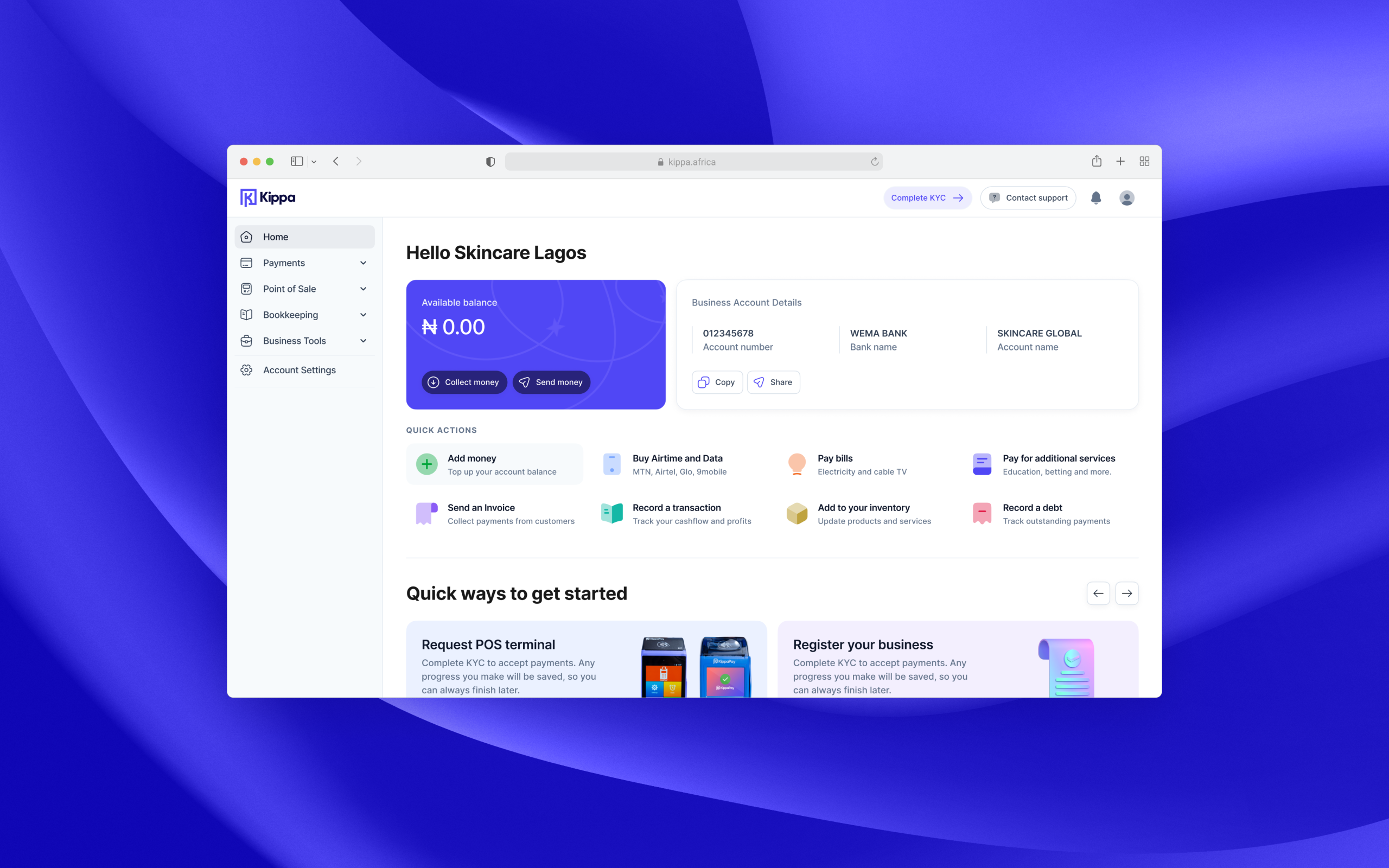
Kippa started as a bookkeeping application for SMEs. As the product grew, features like invoices, inventory management, business cards and were added to the bookkeeping application. We then introduced payments, which enables the SMEs to send and receive money from their customers using Kippa business accounts. With the launch of our agency banking platform, we ushered into financial inclusion for the underserved and enabled micro entrepreneurs who want to earn using the agency banking platform.
Kippa is a financial management platform that helps small and medium-sized businesses manage their finances more efficiently. It was developed to solve the problems associated with traditional accounting software, which can be complicated and require a certain level of technical expertise to use. The aim of KippaPay was to create an intuitive and user-friendly platform that could be used by anyone, regardless of their level of technical knowledge.
As we introspect on how we have evolved over the course of a year, we wanted to redefine the vision for our future such that we are serving one focal customer. This led us to converge all our existing products and capabilities into a business platform product.
The design process for Kippa began with extensive research to understand the target audience and their pain points. The design team conducted user interviews and surveys to gain insights into the problems that businesses face when managing their finances. We also conducted a competitive analysis to identify the strengths and weaknesses of existing financial management software.
Once the research phase was complete, the design team mapped out the information architecture of the product. The platform was designed with multiple features, and the challenge was to create a simple and intuitive interface that would make it easy for users to navigate. To ensure consistency and brand adherence, the design team used Figma to create a design environment with text and color styles.
Furthermore, I created a component library to build out the high-fidelity screens of the product for both web (desktop) and mobile platforms. We tested variants of very interactive high-fidelity prototype with users to gather feedback and iteratively made changes based on user feedback to ensure that the product met the needs of the target audience.
The most innovative aspect of the design is the fluid navigation throughout a user's journey. This aspect is of paramount importance in the current digital landscape. With the ever-increasing competition and the short attention span of users, it has become crucial for businesses to provide a seamless user experience. The design team achieved this by breaking down each feature and path to the atomic level, which allowed us to understand the intricacies of the user journey. We organized features and sub-features into pages and used tabs for in-page navigation, which made the user journey even more streamlined. This meant that users were always only three clicks away (maximum) from any task, resulting in a frictionless user journey and a delightful experience for users. It is worth noting that this approach not only enhances the user experience but also improves the conversion rate for the business. A positive user experience leads to higher customer satisfaction, which in turn leads to customer loyalty and advocacy.
The Kippa platform enables small and medium-sized businesses to accept digital payments from their customers using a variety of methods, including credit and debit cards, bank transfers, and USSD. This feature allows businesses to increase their revenue streams by providing customers with a convenient and secure way to pay for goods and services.
KippaPay makes it easy for businesses to send and receive money from their customers, suppliers, and other stakeholders. This feature allows businesses to manage their cash flow more effectively and ensures that transactions are processed quickly and securely.
KippaPay makes it easy for businesses to add money to a business bank account. This feature allows businesses to manage their cash flow more effectively and ensures that transactions are processed quickly and securely.
KippaPay allows businesses to pay bills and fees, including electricity bills, betting fees, cable TV payments, and airtime/data purchases. This feature simplifies the payment process for businesses and ensures that bills are paid on time, avoiding late fees and penalties.
With KippaPay, businesses can manage their finances more efficiently through bookkeeping features such as invoicing, debt tracking, inventory management, and cashbook. This feature enables businesses to keep track of their financial transactions and stay organized, which is crucial for making informed decisions.
With KippaPay, businesses can manage their finances more efficiently through bookkeeping features such as invoicing, debt tracking, inventory management, and cashbook. This feature enables businesses to keep track of their financial transactions and stay organized, which is crucial for making informed decisions.
With KippaPay, businesses can manage their finances more efficiently through bookkeeping features such as invoicing, debt tracking, inventory management, and cashbook. This feature enables businesses to keep track of their financial transactions and stay organized, which is crucial for making informed decisions.
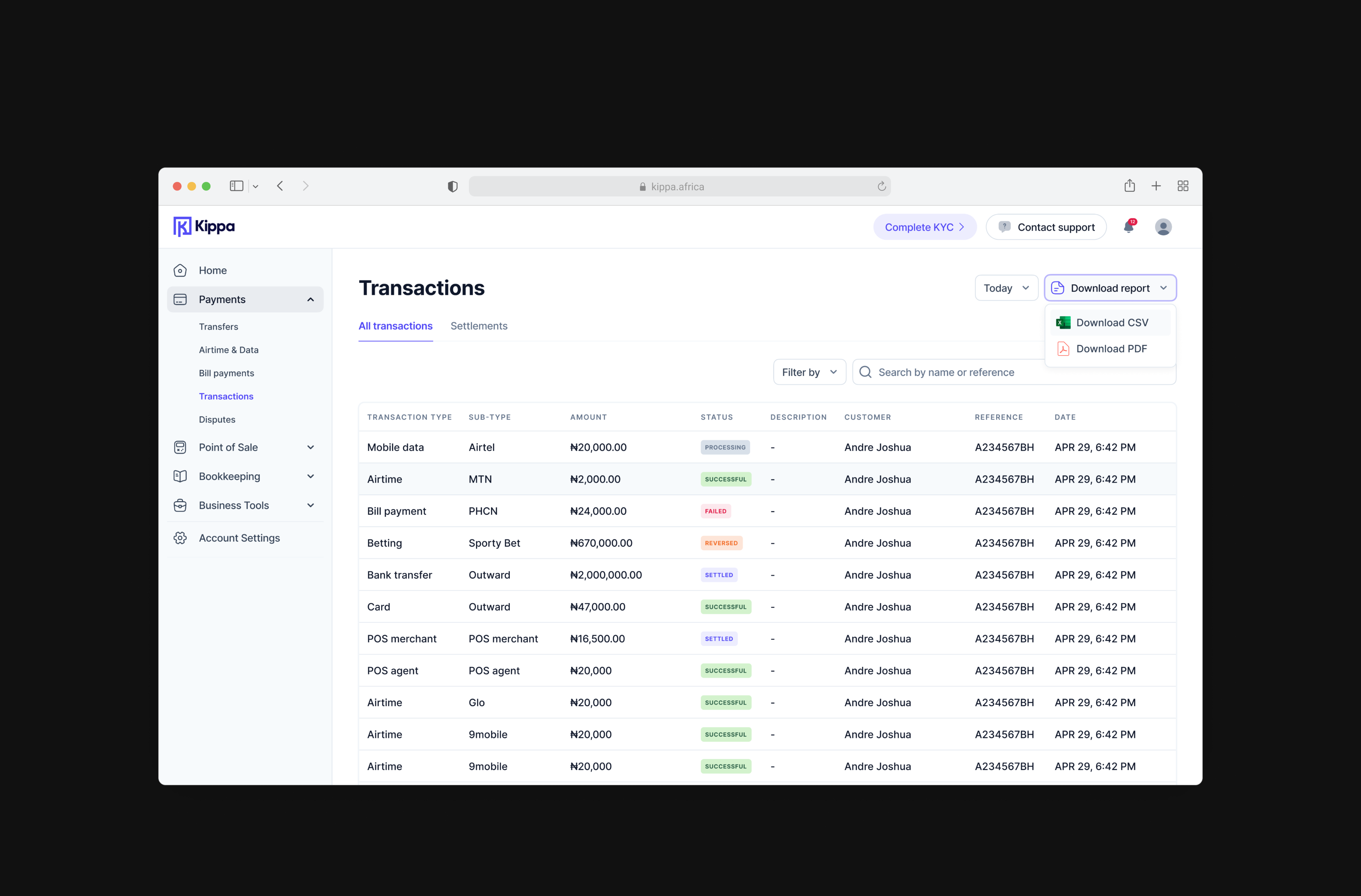
KippaPay provides businesses with the ability to view profit and loss reports for their businesses within a certain time period. This feature enables businesses to track their financial performance and identify areas for improvement.
With KippaPay, businesses can generate parallel income through agency banking. This feature enables businesses to earn additional revenue by acting as agents for financial institutions and providing banking services to their customers.
With KippaPay, businesses can generate parallel income through agency banking. This feature enables businesses to earn additional revenue by acting as agents for financial institutions and providing banking services to their customers.
To start a new business in Nigeria, it is necessary to register the business name with the Corporate Affairs Commission (CAC). Though the registration process can be complicated and time-consuming, Kippa Start can help simplify it. Our Kippa Start feature provides step-by-step guidance to set up your account and begin using the platform. This saves time and helps you quickly start your business, allowing you to concentrate on growth and customer service.
The project encountered a number of challenges throughout its development, which posed serious threats to its successful completion. One of the most significant of these was the addition of a customer relationship management (CRM) feature to the scope of the project at the last minute. This sudden revelation proved to be a major challenge for the team, as we had a hard deadline to deliver the product by the end of the first quarter, and the addition of a new feature at such a late stage in the project's development was sure to affect the estimated timeline and bandwidth.
To solve this challenge, I had to find a way to balance the competing demands on our time and resources. I ultimately chose to delegate some of their pending tasks to a colleague so that I could focus solely on the CRM feature. This allowed me to pour my full attention and energy into the new feature, ensuring that it was properly integrated into the product and met the needs of the target audience. In addition, I also carefully clicked through the existing prototype to identify areas where ‘customers’ might not be properly represented, and made sure to address these issues in the final product.
Another major challenge that the team faced was how to adequately represent the many moving parts of the product in the prototypes. This was a significant problem, as the product was complex and multifaceted, and required a high degree of precision and attention to detail to properly convey its various features and functionalities. To solve this challenge, I engaged in extensive research and consulting with designer friends, exploring a range of different strategies and techniques for representing the product in the most effective way possible. Ultimately, I settled on creating multiple states for the components that required micro-interactions, and prototyping them on the component level. This allowed for a high degree of flexibility and customization in the final prototype, helping to ensure that it accurately reflected the full range of features and functionalities that the product offered.
Finally, the team also faced the significant challenge of making the platform accessible to users with low internet connectivity. This was a particularly important challenge, as the product was designed to be used by a wide range of users, regardless of their location or connectivity status. To solve this issue, the team designed the platform to have low data usage and fast-loading speeds, ensuring that it was accessible to users in areas with poor internet connectivity. This involved a range of different strategies and techniques, including optimizing the platform's code and compressing its images and assets to minimize data usage. Ultimately, these efforts paid off, and the platform was successfully launched and adopted by users around the country.
The Kippa platform has been well received by users and has helped small and medium-sized businesses manage their finances more efficiently. In the future, the design team plans to continue to improve the platform by adding new features and making it even more user-friendly. They also plan to expand the platform to more regions in Africa, helping even more businesses to manage their finances effectively.







.svg)














%201.svg)